


NEWCROSS HEALTHCARE - 2025 - 4 MONTHS
Product Manager on a 0→1, three-app workforce platform taken from fragmented AI prototype to live enterprise pilot
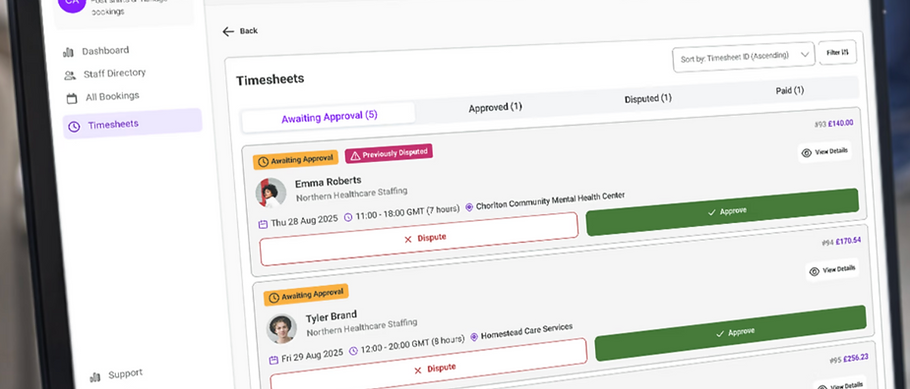
Context
Newcross was developing a new neutral-vendor workforce management platform for large healthcare organisations managing staffing across multiple suppliers.
I took ownership mid-build after an initial version had been created at unusually high speed using AI-assisted development. A large amount of functionality existed, but the product had grown faster than the underlying product definition: workflows were inconsistent, business rules were incomplete, and the three applications did not always behave as one coherent system.
My challenge was to turn that prototype into a product capable of supporting an enterprise pilot under a highly compressed timeline — clarifying what V1 actually needed to do, defining the logic connecting all three applications, reducing scope and introducing the product, design and testing discipline required to get there.
What is it?
The platform is a B2B Vendor Management System designed to let healthcare organisations manage contingent staffing across multiple suppliers through one system.
It consists of three interconnected web applications:
-
Client — organisations create bookings, define requirements, review candidates and manage staffing demand
-
Agency — staffing suppliers receive opportunities, manage workers and submit candidates
-
Admin — internal teams configure organisations, suppliers, permissions and platform rules
The complexity sits in the workflows connecting them: a change made in one application can affect users, permissions, financial rules and booking states across the others.
Core journeys include booking creation and distribution, candidate submission, confirmations, timesheets, compliance, invoicing, disputes and multi-level organisational structures.
~150
Features mapped across the platform
~40%
V1 scope removed from OG roadmap
3
Interconnected web applications
1
Live enterprise pilot
~4 months
Prototype → enterprise pilot
Achievements
Re-established product foundations around a fragmented AI-built prototype
When I inherited the platform, functionality had been produced faster than a coherent product model had formed.
I audited the product end-to-end and mapped approximately 150 existing and planned features across the client, agency and admin applications.
This exposed:
-
duplicated or unclear functionality
-
missing business rules
-
inconsistent states across applications
-
frontend experiences without complete backend logic
-
dependencies that had not been designed end-to-end
I rebuilt the product definition around complete user journeys rather than individual screens and features.
Impact
-
created a shared view of the full platform and its dependencies
-
established consistent cross-app business rules
-
gave Engineering, Design and business stakeholders a common source of product truth
-
turned a collection of rapidly built functionality into a coherent product model the team could design, build and test end-to-end
Cut ~60 features from V1 to protect the enterprise release
The inherited scope was too large for the available timeline and not every feature was required to validate the proposition with an enterprise customer.
I reviewed the ~150-feature product map against core customer workflows, dependencies, business risk and release requirements.
Rather than treating everything already designed or built as committed scope, I removed or deferred approximately 60 features from V1 and concentrated effort on the journeys required for the platform to function coherently.
Impact
-
reduced V1 scope by roughly 40%
-
concentrated limited capacity on the workflows required for enterprise validation
-
reduced unnecessary cross-app complexity
-
created a clearer boundary between pilot-critical functionality and subsequent product expansion
Defined the cross-app logic behind a three-sided platform
The core product challenge was not the individual interfaces — it was ensuring that every action remained logically consistent across clients, agencies and internal administrators.
I defined and reconciled business rules across areas including:
-
booking creation and distribution
-
candidate submission and assignment
-
organisational hierarchies and permissions
-
timesheet approval
-
compliance
-
disputes
-
invoicing and commercial workflows
I worked closely with Engineering, Design, Finance, Customer teams and leadership to resolve edge cases quickly and ensure each workflow worked across the full system rather than within one application in isolation.
Outcome
-
created coherent end-to-end journeys across all three applications
-
surfaced hidden dependencies before they reached client testing
-
gave the team a clearer framework for building subsequent functionality consistently
Took the product from prototype through enterprise demonstration and live pilot
The product was being developed against an aggressive commercial timeline while requirements continued to change.
I introduced a tighter cross-functional operating rhythm around Product, Design, Engineering, Finance and customer-facing teams so that open business decisions could be resolved quickly rather than becoming engineering assumptions.
The approach combined:
-
daily decision-making loops
-
rapid design and product validation
-
explicit business-rule definition
-
progressive testing across applications
-
scope control around pilot-critical journeys
The platform was successfully demonstrated to the prospective enterprise customer and subsequently progressed into a live enterprise pilot before I handed the programme to another team.
Outcome
-
moved the platform from fragmented prototype into live enterprise validation
-
established a coherent baseline that subsequent teams could continue building from
-
established the product and delivery structure used after my handover
Learnings
What AI changed about the Product role
The platform demonstrated how dramatically AI-assisted development can compress implementation time. Functionality that would traditionally have been split across several engineering tickets could sometimes be implemented within a day.
But that did not remove Product work — it moved the bottleneck.
As development accelerated, the limiting factors increasingly became:
-
deciding what should actually be built
-
defining complete business rules
-
resolving edge cases
-
aligning stakeholders quickly enough
-
validating interactions across multiple applications
-
testing whether rapidly generated functionality behaved correctly
I adapted the team's way of working accordingly: we increasingly discussed and validated complete features and workflows rather than individual engineering tickets, while using tighter cross-functional decision loops to keep Product, Design, Engineering and the business aligned.
Key lessons from AI-assisted delivery
-
AI accelerates implementation faster than decision-making
Building faster only creates value if the team can define, validate and prioritize at the same speed. -
Product coherence matters more as build cost falls
AI can generate large amounts of functionality quickly; it does not automatically create a coherent product. -
The bottleneck moves toward definition, integration and QA
The programme reinforced that faster coding increases the value of precise business rules, edge-case definition, cross-system validation and testing.
The experience also challenged the assumption that faster coding automatically produces a faster release. Individual features could be implemented extremely quickly, but the overall programme still required additional time because product definition, cross-app integration, testing and stakeholder decisions became the real constraints.
Key impact
-
Took ownership of a fragmented AI-built VMS and mapped ~150 features across three interconnected applications
-
Removed ~60 features from V1, focusing limited capacity on the workflows required for enterprise validation
-
Defined cross-app business rules and end-to-end workflows spanning clients, staffing agencies and internal administrators
-
Introduced a high-speed cross-functional decision model adapted to AI-accelerated development
-
Took the platform from prototype through enterprise demonstration and into a live client pilot before handover
-
Demonstrated how AI shifts Product's bottleneck from implementation toward prioritization, product definition, integration and validation


